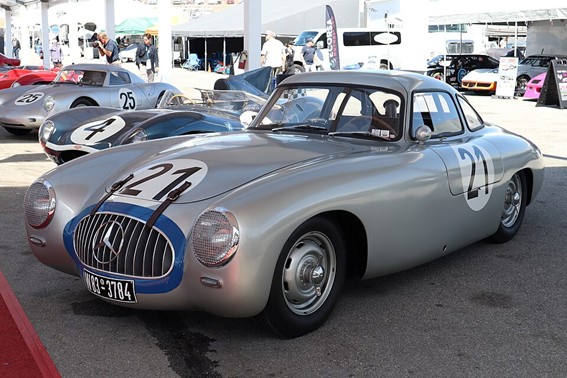
“Mercedes 300 SL W194 at RMMR 2022” by Prova MO is licensed under CC BY-SA 4.0.
Few words can describe how immense the accomplishments of Rudolf Caracciola were. Many people talk about Formula 1, but it didn’t just appear out of thin air in 1950 with the likes of more memorable heroes such as Juan Manuel Fangio, Alberto Ascari or Giuseppe Farina.
The AIACR European Championship, a precursor of today’s Formula 1, held six full seasons, three of which were won by “Caratsch”: the most out of any driver. The German of Italian descent, who also held Swiss citizenship but never raced under said flag, also finished an honourable third with Alfa Romeo in 1932. These achievements undoubtedly make him one of, if not the best, driver of the pre-F1 era. And whilst his prime time, cut short by World War II, was quite obviously before the 50’s, few people remember his short-lived and not-so-successful comeback, which was somewhat involved with “modern” Formula 1.
Long past his best years and already aged 51, Rudolf Caracciola decided to compete in a support race that was “part” of the 1952 Swiss Formula 1 Grand Prix event. It was not F1 itself, not quite, but a sportscar race of that level after a comeback from a serious leg injury was nothing short of impressive. Make no mistake, the “Rain Master”, as he was called during his winning days, had nothing to prove. Long before the births of Lewis Hamilton and Nico Rosberg, he had become synonymous with Mercedes and was, back then, the most successful Grand Prix car driver of all time.
Whilst the Formula 1 Swiss Grand Prix was won by Ferrari’s Piero Taruffi, the “Prix de Bremgarten for Sportscars”, named after the Bremgarten Circuit it was held at, was not short of stars. One of his Mercedes team-mates was Hermann Lang; 3rd place in the 1937 and 1938 European Championship seasons and now officially an F1 driver. His other two team-mates, Fritz Riess and Karl Kling, also had the honour of having participated in the top class, the former of which won the 24 Hours of Le Mans alongside Lang himself later that year. Bonetto at Lancia, Biondetti at Jaguar, Duke and Parnell at Aston Martin and F1 race winner Luigi Fagioli at Lancia also participated in the race.
The “Silver Arrow” driven by Rudolf Caracciola was none other than the legendary Mercedes-Benz W194 300 SL. Caracciola had fond memories of the car, as he and navigator Paul Kurrle had managed a 4th place at Automobile Club di Brescia’s Millie Miglia two weeks prior in that same machinery, in what was Caracciola’s. first major race post-comeback.
In Bern, however, Swiss Sportscar Champion and home hero Willie Daetwyler of Ferrari took pole position in qualifying ahead of Kling (2nd) and Caracciola (3rd). “Caratsch” managed to outqualify team-mates Lang (4th) and Reiss (11th), although with the latter’s unique disadvantage of having to handle a previously unraced car.
Three of the Mercedes-Benz W1940 300 SL cars ended on the podium. Karl Kling was the winner of the race, whilst Hermann Lang (who also took fastest lap) and Fritz Riess would accompany him in 2nd and 3rd, respectively. Sadly for Caracciola, the brakes on car #005 suffered a critical failure which meant the German would end up colliding against a tree. Whilst he survived, the injuries from another dangerous crash were, this time, career-ending. A wheelchair and a walking stick would accompany the Remagen-born champion, from that point onwards a Mercedes-Benz salesman, until his death of liver failure at 58.
Leave a Reply